answer.
Ask question
Login Signup
Ask question
All categories
  • English
  • Mathematics
  • Social Studies
  • Business
  • History
  • Health
  • Geography
  • Biology
  • Physics
  • Chemistry
  • Computers and Technology
  • Arts
  • World Languages
  • Spanish
  • French
  • German
  • Advanced Placement (AP)
  • SAT
  • Medicine
  • Law
  • Engineering
liberstina [14]
2 years ago
13

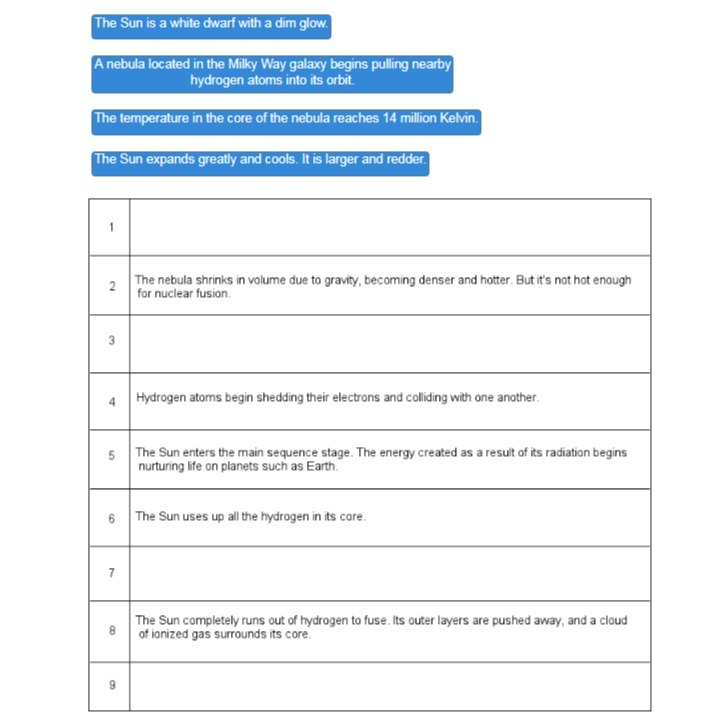
The table shows chronological events in the life of our Sun, a medium-sized star. Place the missing events into the correct rows

of the table.

Physics
1 answer:
SCORPION-xisa [38]2 years ago
4 0

Answer:

The Sun is a medium sized star present at the center of the solar system. It is primarily formed of Hydrogen and Helium. Like other stars, Sun was also born in a Nebula, and moved on to become a Main sequence star. It has a lifespan of about 10 billion years. At the end of its life when all the hydrogen fused into higher elements, the Sun would eventually throw out majority of its mass and the core would survive as a white dwarf.

The correct chronological order of events is:

1. A nebula located in the Milky Way galaxy begins pulling nearby hydrogen atoms in its orbit.

2. The Nebula shrinks in its volume due to gravity, becoming denser and hotter. But, it's not hot enough for nuclear fusion.

3. The temperature in the core of the Nebula reaches 14 million Kelvin.

4. Hydrogen atoms begin shedding their electrons and colliding with one another.

5. The Sun enters the main sequence stage. The energy created as a result of  its radiation begins nurturing life on planet such as Earth.

6. The Sun uses up all the hydrogen in its core.

7. The Sun expands greatly and cools . It is larger and redder.

8. The Sun completely runs out of hydrogen to fuse. Its outer layers are pushed away, and a cloud of ionized gas surrounds its core.

9. The Sun is a white dwarf with a dim glow.
You might be interested in
Consider two circular metal wire loops each carrying the same current I as shown below. In what r... Consider two circular metal
NeX [460]

Answer:

1) The magnetic field outside the loop is zero.

In region III the magnetic fields due to the two wire loops point in the opposite direction andhence cancel each other. Therefore the magnetic field is zero in region I, III and V

The diagram is attached

6 0
2 years ago
an object having a core temperature of 1700 is removed from a furnace and placed in an environment having a constant temperature
IRINA_888 [86]

Answer: It will be take 2.6 hours

Explanation: Please see the attachments below

4 0
2 years ago
A 100 cm3 block of lead weighs 11N is carefully submerged in water. One cm3 of water weighs 0.0098 N.
Pie

#1

Volume of lead = 100 cm^3

density of lead = 11.34 g/cm^3

mass of the lead piece = density * volume

m = 100 * 11.34 = 1134 g

m = 1.134 kg

so its weight in air will be given as

W = mg = 1.134* 9.8 = 11.11 N

now the buoyant force on the lead is given by

F_B = W - F_{net}

F_B = 11.11 - 11 = 0.11 N

now as we know that

F_B = \rho V g

0.11 = 1000* V * 9.8

so by solving it we got

V = 11.22 cm^3

(ii) this volume of water will weigh same as the buoyant force so it is 0.11 N

(iii) Buoyant force = 0.11 N

(iv)since the density of lead block is more than density of water so it will sink inside the water


#2

buoyant force on the lead block is balancing the weight of it

F_B = W

\rho V g = W

13* 10^3 * V * 9.8 = 11.11

V = 87.2 cm^3

(ii) So this volume of mercury will weigh same as buoyant force and since block is floating here inside mercury so it is same as its weight =  11.11 N

(iii) Buoyant force = 11.11 N

(iv) since the density of lead is less than the density of mercury so it will float inside mercury


#3

Yes, if object density is less than the density of liquid then it will float otherwise it will sink inside the liquid

3 0
2 years ago
You throw a baseball straight up into the air with a speed of 24.5 m/s. How long does it take the baseball to reach its highest
galben [10]
Time=speed/acceleration
Gravitaional Acceleration=9.8 m/s^2
Speed=24.5 m/s
Time=24.5/9.8=2.5 s
3 0
2 years ago
Read 2 more answers
The k of a material is defined as the resistance of the wire made from that material which is ? long, and in diameter.
Elodia [21]
90 meaters longer than you
8 0
2 years ago
Other questions:
  • A granite monument has a volume of 25,365.4 cm3. The density of granite is 2.7 g/cm3. Use this information to calculate the mass
    10·1 answer
  • A hydraulic press must be used to press-fit two components together in an assembly process. the system must generate at least 77
    13·1 answer
  • A bullet blasts from the barrel of a gun upward in the vertical direction with an initial speed of 700 m/s . Find the maximum al
    15·1 answer
  • An airplane traveling 245 m/s east experienced turbulence, so the pilot decided to slow down to 230 m/s. It took the pilot 7 sec
    6·2 answers
  • The Earth has a magnetic field around it, which is generated by its molten core. This magnetic field exerts a force on compass d
    5·2 answers
  • An electric field of 4.0 μV/m is induced at a point 2.0 cm from the axis of a long solenoid (radius = 3.0 cm, 800 turns/m). At w
    9·1 answer
  • Assume your eye has an aperture diameter of 3.00 mm at night when bright headlights are pointed at it. 1) At what distance can y
    13·2 answers
  • Suppose you are myopic (nearsighted). You can clearly focus on objects that are as far away as 52.5 cm away. You can clearly foc
    10·1 answer
  • Stu wanted to calculate the resistance of a light bulb
    11·2 answers
  • A substance occupies one half of an open container. The atoms of the substance are closely packed but are still able to slide pa
    6·1 answer
Add answer
Login
Not registered? Fast signup
Signup
Login Signup
Ask question!
