answer.
Ask question
Login Signup
Ask question
All categories
  • English
  • Mathematics
  • Social Studies
  • Business
  • History
  • Health
  • Geography
  • Biology
  • Physics
  • Chemistry
  • Computers and Technology
  • Arts
  • World Languages
  • Spanish
  • French
  • German
  • Advanced Placement (AP)
  • SAT
  • Medicine
  • Law
  • Engineering
RUDIKE [14]
2 years ago
3

Old naval ships fired 10 kg cannon balls from a 240 kg cannon. It was very important to stop the recoil of the cannon, since oth

erwise the heavy cannon would go careening across the deck of the ship. In one design, a large spring with spring constant 2.0×10⁴ N/m was placed behind the cannon. The other end of the spring braced against a post that was firmly anchored to the ship's frame.
What was the speed of the cannon ball if the spring compressed 55 cm when the cannon was fired?

Express your answer to two significant figures and include the appropriate units.
Physics
1 answer:
blondinia [14]2 years ago
8 0

Answer:

120 m/s

Explanation:

First of all, we can find the speed of the cannon recoiling. In fact, when the cannon recoils with speed V', it compresses the spring and all its kinetic energy is converted into elastic potential energy of the spring. So we can write:

\frac{1}{2}MV'^2 = \frac{1}{2}kx^2

where

M = 240 kg is the mass of the cannon

V is the speed of recoil of the cannon

k = 2.0×10^4 N/m is the spring constant

x = 55 cm = 0.55 m is the compression of the spring

Solving for V',

V' = \sqrt{\frac{kx^2}{M}}=\sqrt{\frac{(2.0\cdot 10^4)(0.55)^2}{240}}=5.0 m/s

Now we can apply instead the law of conservation of momentum to the cannon+cannonball system to find the velocity at which the cannonball is fired. Since the system is initially at rest, the initial momentum is zero, so we can write:

0=mv+MV'

where

m = 10 kg is the mass of the cannon ball

v is the velocity of the cannon ball

M = 240 kg is the mass of the cannon

V' = 5.0 m/s is the velocity of recoil of the cannon

Solving for v,

v=-\frac{MV'}{m}=-\frac{(240)(5.0)}{10}=-120 m/s

where the negative sign means the direction of the cannonball is opposite to that of the cannon. So, the cannonball is fired at a speed of 120 m/s.


You might be interested in
A mover hoists a 50 kg box from the ground to a height of 2 m. What was the change in the box's energy
SSSSS [86.1K]

Answer:

980 J

Explanation:

The change in box's energy is equal to its change in gravitational potential energy:

\Delta U = m g \Delta h

where

m = 50 kg is the mass of the box

g = 9.8 m/s^2 is the acceleration due to gravity

\Delta h= 2m is the change in height of the box

Substituting numbers, we find

\Delta U = (50 kg)(9.8 m/s^2)(2 m)=980 J

3 0
2 years ago
Which of the following is not a factor in whether a reaction will spontaneously occur? A. Entropy change of the system B. Enthal
Delvig [45]

Answer:

D

Explanation:

pressure change have nothing to do with the spontaneity.

Entropy change , enthalpy change , temperature have roles in deciding spontaneity.

6 0
2 years ago
A 60.0-kg mass person wishes to push a 120-kg mass box across a level floor. The coefficient of static friction between the pers
Aneli [31]

Answer:

μ = 0.350

Explanation:

For the person to able to move the box, the force exerted by the person on the box must equal the force exerted by the box:

F_{p} = F_{b}

In this case, force can be calculated as a product of mass (m) by the acceleration of gravity (g) and the coefficient of static friction (μ):

m_{p}*g*\mu_{p}=m_{b}*g*\mu_{b}\\m_{p}*\mu_{p}=m_{b}*\mu_{b}\\60*0.7=120*\mu_{b}\\\mu_{b}= 0.35

Therefore, for the person to be able to push the box horizontally, the coefficient of static friction between the box and the floor should not be higher than 0.350.

8 0
2 years ago
Alculate the potential difference if 20J of energy are transferred by 8C of charge.
sveta [45]

Answer:

V = 2.5 J/C

Explanation:

<u><em>Given:</em></u>

Energy = E = 20 J

Charge = Q = 8 C

<u><em>Required:</em></u>

Potential Difference = V = ?

<u><em>Formula:</em></u>

V = \frac{E}{Q}

<u><em>Solution:</em></u>

V = 20/8

V = 2.5 J/C

6 0
2 years ago
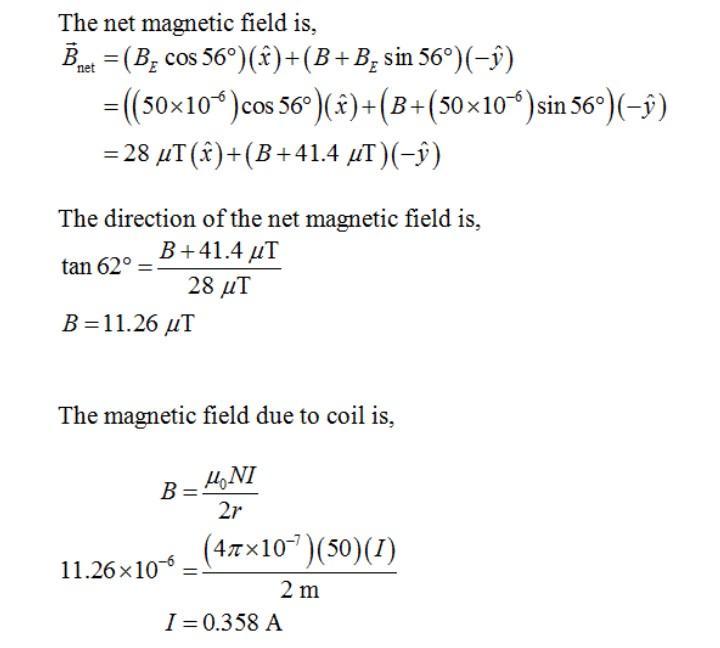
At the equator, the earth’s field is essentially horizontal; near the north pole, it is nearly vertical. In between, the angle v
Yanka [14]

Answer:

A current of 0.358A is required

Explanation:

Pls refer to attached document for more details

7 0
2 years ago
Other questions:
  • Water has a specific heat of 4.186 J/g°C, and ethanol has a specific heat of 2.450 J/g°C. Based on this information, which best
    13·2 answers
  • In the Atwood machine shown below, m1 = 2.00 kg and m2 = 6.05 kg. The masses of the pulley and string are negligible by comparis
    6·1 answer
  • what shall be the effect on the least count of spherometer if number of divisions on its circular scale be doubled?
    12·1 answer
  • Two disks with the same rotational inertia i are spinning about the same frictionless shaft, with the same angular speed ω, but
    8·1 answer
  • Add a third force that will cause the object to remain at rest. Label the new force F⃗ 3. Draw the vector starting at the black
    8·1 answer
  • Given three different locations on Earth's surface, where will the weight of a person be greatest? in New York City, which is ab
    13·1 answer
  • Given a 100-watt power source, what is the maximum allowable length for the 24-guage transmission media if a signal of 1 Watt is
    9·1 answer
  • Index of refraction
    15·1 answer
  • 1200 N-m of torque is used to drive a gear (A) of diameter 25 cm, which in turn drives another gear (B) of diameter 52 cm. What
    11·2 answers
  • If John mows 11.5 meters of lawn from east
    12·1 answer
Add answer
Login
Not registered? Fast signup
Signup
Login Signup
Ask question!