answer.
Ask question
Login Signup
Ask question
All categories
  • English
  • Mathematics
  • Social Studies
  • Business
  • History
  • Health
  • Geography
  • Biology
  • Physics
  • Chemistry
  • Computers and Technology
  • Arts
  • World Languages
  • Spanish
  • French
  • German
  • Advanced Placement (AP)
  • SAT
  • Medicine
  • Law
  • Engineering
s2008m [1.1K]
2 years ago
12

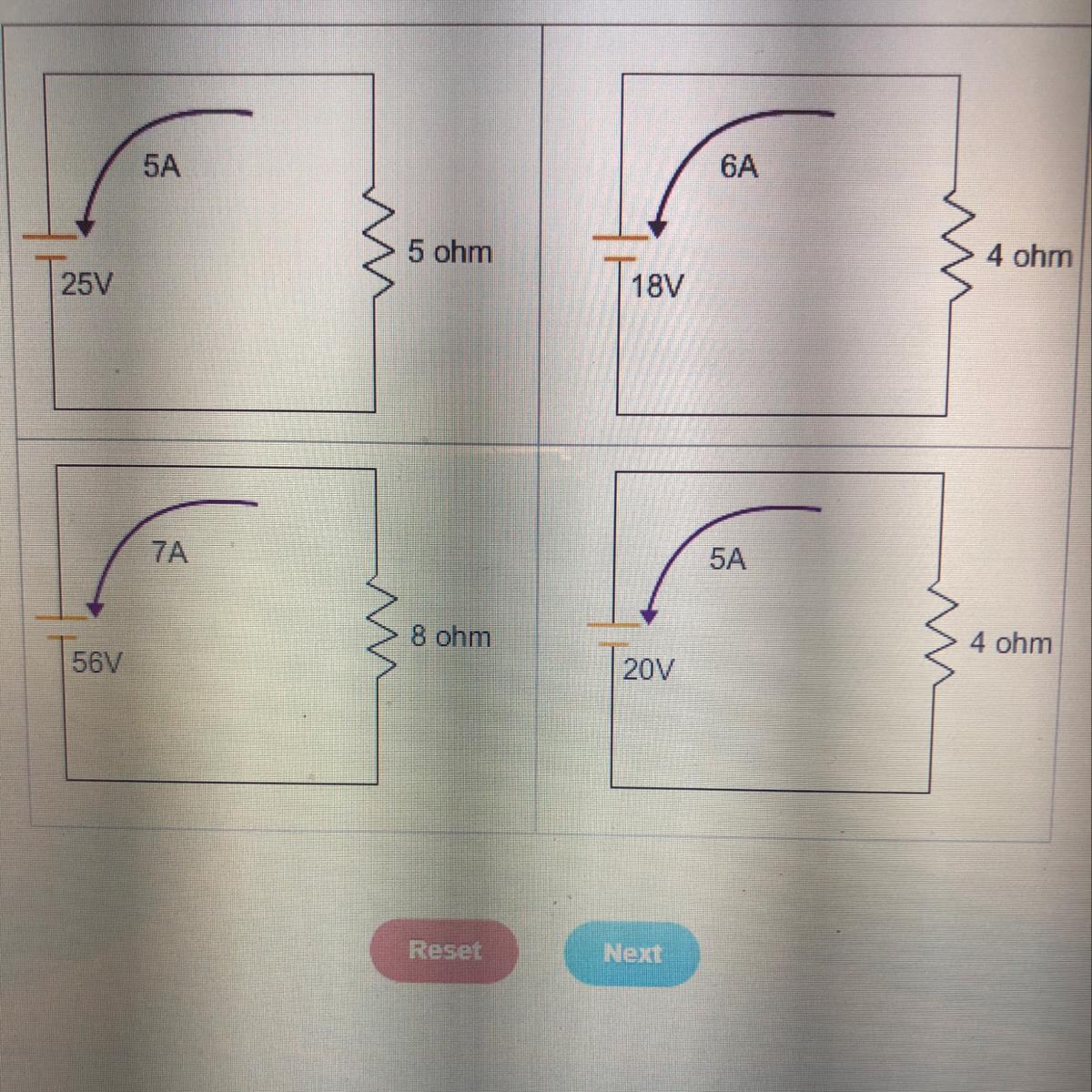
Which circuits correctly show Ohm's law?

Physics
2 answers:
Elodia [21]2 years ago
6 0
Ohm’s Law:
V = IR
V = battery voltage, I = current, R = resistance

Top-left circuit:
V = 25V, I = 5A, R = 5ohm
25 = 5•5
25 = 25
This circuit is correct.

Top-right circuit:
V = 18V, I = 6A, R = 4ohm
18 = 6•4
18 =/= 24
This circuit is incorrect.

Bottom-left circuit:
V = 56V, I = 7A, R = 8ohm
56 = 7•8
56 = 56
This circuit is correct.

Bottom-right circuit:
V = 20V, I = 5A, R = 4ohm
20 = 5•4
20 = 20
This circuit is correct.

The following circuits are correct: top-left, bottom-left, and bottom-right.
Amiraneli [1.4K]2 years ago
5 0

Answer:

the top left and the bottom left and the bottom right

You might be interested in
A particle is moving along the x-axis. Its position as a function of time is given as x=bt-ct^2a) What must be the units of the
lisabon 2012 [21]

Answer:

We are given x= bt +ct²

So

A. bxt= m

Because m/s*s= m

So b= m/s and c= m/s²

B.

x= bt-ct²

So at x=0 t=0

x=0 t= 2

We have

bt = ct² so t = b/c at x= 0

So b-2ct= 0

B. To find velocity we use

dx / dt = b - 2 Ct

C. At rest wen V= 0

We have t= b/2c

D. To find acceleration we use

dv / dt = - 2C

3 0
2 years ago
You hold a piece of wood in one hand and a piece of iron in the other. both pieces have the same volume, and you hold them fully
aivan3 [116]
You hold a piece of wood in one hand and a piece of iron in the other. Both pieces have the same volume, and you hold them fully under water at the same depth. At the moment you let go of them, which one experiences the greater buoyancy force?<span>
</span>
5 0
2 years ago
A 6.0-cm-diameter, 11-cm-long cylinder contains 100 mg of oxygen (O2) at a pressure less than 1 atm. The cap on one end of the c
butalik [34]

Answer:

The temperature of the gas is 1197.02 K

Explanation:

From ideal gas law;

PV = nRT

Where;

P is the pressure of the gas

V is the volume of the gas

R is ideal gas constant = 8.314 L.kPa/mol.K

T is the temperature of the gas

n is the number of moles of gas

Volume of the gas in the cylindrical container = πr²h

Given;

r = 6/2 = 3 cm = 0.03 m

h = 11 cm = 0.11 m

V = π × (0.03)² × 0.11 = 3.11 × 10⁻⁴ m³ = 0.311 L

number of moles of oxygen gas = Reacting mass / molar mass

=\frac{0.1}{32} = 0.003125, moles

T = \frac{PV}{nR} = \frac{100X0.311}{0.003125X8.314} =1197.02K

Therefore, the temperature of the gas is 1197.02 K

6 0
2 years ago
In a power plant, pipes transporting superheated vapor are very common. Superheated vapor flows at a rate of 0.3 kg/s inside a p
grigory [225]

Answer:h=160.84 W/m^2-K

Explanation:

Given

mass flow rate=0.3 kg/s

diameter of pipe=5 cm

length of pipe=10 m

Inside temperature=22

Pipe surface =100

Temperature drop=30

specific heat of vapor(c)=2190 J/kg.k

heat supplied Q=mc\Delta T=0.3\times 2190\times (30)

Heat due to convection =hA(100-30)

A=\pi d\cdot L

A=\pi 0.05\times 10=1.571 m^2

Q_{convection}=h\times 1.571\times (100-22)=122.538 h

Q=Q_{convection}

19,710=122.538 h

h=160.84 W/m^2-K

5 0
2 years ago
Gibbons, small Asian apes, move by brachiation, swinging below a handhold to move forward to the next handhold. A 9.4 kg gibbon
Katarina [22]

Answer:

upward force acting = 261.6 N

Explanation:

given,

mass of gibbon = 9.4 kg

arm length = 0.6 m

speed of the swing

net force must provide

F_{branch} + F_{gravity}=F_{centripetal}

force of gravity = - mg

F_{branch}=F_{centripetal}-F_{gravity}

                        = \dfrac{mv^2}{r} + mg

                        = m(\dfrac{3.4^2}{0.6} +9.8)

                        =9 x 29.067

                        = 261.6 N

upward force acting = 261.6 N
7 0
2 years ago
Other questions:
  • What is the sources of error and suggestion on how to overcome it in the hooke's law experiment?
    15·1 answer
  • A car moving 12 m/s stops in 3 seconds vf=
    15·2 answers
  • describe how the piece of chalk in this image may be affected by static friction, sliding friction, fluid friction and rolling f
    9·2 answers
  • A point charge of 6.8 C moves at 6.5 × 10⁴ m/s at an angle of 15° to a magnetic field that has a field strength of 1.4 T.
    5·2 answers
  • An electron beam enters a crossed-field velocity selector with magnetic and electric fields of 2.0 mT and 6.0×10^3 N/C, respecti
    11·1 answer
  • .Find the uncertainty in a calculated electrical potential difference from the measurements of current and resistance. Electric
    8·1 answer
  • Assume you are given an int variable named nElements and a 2-dimensional array that has been created and assigned to a2d. Write
    11·1 answer
  • a 2.0 kg hoop rolls without slipping on a horizontal surface so that its center proceeds to the right with a constant linear spe
    7·1 answer
  • a water heater has a power rating of 1 kW. how many seconds will this heater take to boil 1 liter of water?
    9·1 answer
  • At what angle should the axes of two Polaroids be placed so as to reduce the intensity of the incident unpolarized light to
    13·1 answer
Add answer
Login
Not registered? Fast signup
Signup
Login Signup
Ask question!
