answer.
Ask question
Login Signup
Ask question
All categories
  • English
  • Mathematics
  • Social Studies
  • Business
  • History
  • Health
  • Geography
  • Biology
  • Physics
  • Chemistry
  • Computers and Technology
  • Arts
  • World Languages
  • Spanish
  • French
  • German
  • Advanced Placement (AP)
  • SAT
  • Medicine
  • Law
  • Engineering
scZoUnD [109]
2 years ago
6

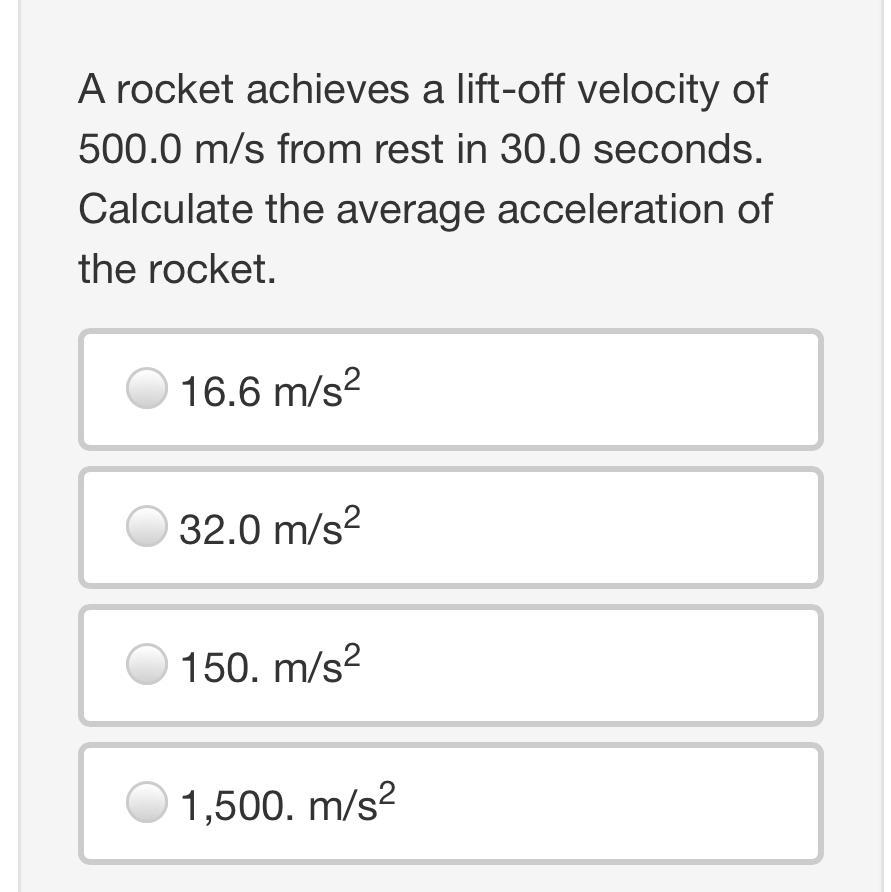
A rocket achieves a lift-off velocity of 500.0 m/s from rest in 30.0 seconds. Calculate the average acceleration of the rocket.

Physics
1 answer:
Anettt [7]2 years ago
6 0

Answer:

The average acceleration is 16.6 m/s² ⇒ 1st answer

Explanation:

A rocket achieves a lift-off velocity of 500.0 m/s from rest in

30.0 seconds

The given is:

→ The initial velocity = 0

→ The final velocity = 500 meters per seconds

→ The time is 30 seconds

Acceleration is the rate of change of velocity of the rocket

→ a=\frac{v-u}{t}

where a is the acceleration, v is the final velocity, u is the initial velocity

and t is the time

→ u = 0 , v = 500 m/s , t = 30 s

Substitute these values in the rule

→ a=\frac{500-0}{30}=\frac{500}{30}=16.6 m/s²

<em>The average acceleration is 16.6 m/s²</em>

You might be interested in
A puppy finds a rawhide bone and begins to pull it with a force, Ft. The free-body diagram is shown. Which describes what happen
Anastasy [175]
It begins to move towards the right
8 0
2 years ago
Read 2 more answers
Find the average power Pavg created by the force F in terms of the average speed vavg of the sled.
Katena32 [7]

Complete Question

The complete question is shown on the first and second uploaded image

Answer:

The power created  is  P_{avg} =  F  *  v_{avg}

Explanation:

From the question we are told that

    The that the average power is  mathematically represented as

            P_{avg} =  \frac{W }{\Delta  t  }

Where W is  is the Workdone which is  mathematically represented as

         W =  F  *  s

      Where F is  the applies force and  s  is the displacement  due to the force  

        So  

                P_{avg} =  \frac{F *s  }{\Delta  t  }

Now this  displacement can be represented mathematically as  

            s =  v_{avg} *  \Delta  t

Where v_{avg } is the average  velocity and \Delta  t is the time  taken  

So  

            P_{avg} =  \frac{F *v_{avg} *  \Delta  t    }{\Delta  t  }

=>         P_{avg} =  F  *  v_{avg}

3 0
2 years ago
Ronald likes to use his erector set more than anything else.
Rashid [163]
C: Foreclosure. People in identity foreclosure have committed to an identity too soon. Often they have simply adopted the identity of a parent, close relative or respected friend.
5 0
2 years ago
Read 2 more answers
According to Dr. paul Narguizian professor of Biology and Science Education at California State University, ______ are generaliz
Mazyrski [523]

Answer:

I believe the correct answer would be A :)

Explanation:

3 0
1 year ago
Lilli suggests that they explore the simulation starting with varying only a single parameter in order to understand the role of
mrs_skeptik [129]

Answer:

B.

Explanation:

One of the ways to address this issue is through the options given by the statement. The concepts related to the continuity equation and the Bernoulli equation.

Through these two equations it is possible to observe the behavior of the fluid, specifically the velocity at a constant height.

By definition the equation of continuity is,

A_1V_1=A_2V_2

In the problem A_2 is 2A_1, then

A_1V_1=2A_1V_2

V_2 = \frac{V_1}{2}

<em>Here we can conclude that by means of the continuity when increasing the Area, a decrease will be obtained - in the diminished times in the area - in the speed.</em>

For the particular case of Bernoulli we have to

P_1 + \frac{1}{2}\rho V_1^2 = P_2 +\frac{1}{2}\rho V_2^2

P_2-P_1 = \frac{1}{2} \rho (V_1^2-V_2^2)

For the previous definition we can now replace,

P_2-P_1 = \frac{1}{2} \rho (V_1^2-(\frac{V_1}{2})^2)

\Delta P =  \frac{3}{8} \rho V_1^2

<em>Expressed from Bernoulli's equation we can identify that the greater the change that exists in pressure, fluid velocity will tend to decrease</em>

The correct answer is B: "If we increase A2 then by the continuity equation the speed of the fluid should decrease. Bernoulli's equation then shows that if the velocity of the fluid decreases (at constant height conditions) then the pressure of the fluid should increase"
4 0
2 years ago
Other questions:
  • Fill in the blanks. The electrostatic force between two objects is proportional to the ____________________ of the distance ____
    5·2 answers
  • Why did the acorn fall to earth instead of rising up to the moon?
    8·2 answers
  • How does the sun's energy help maintain Earth's energy budget? A part of it is trapped by carbon dioxide and methane. A part of
    7·2 answers
  • A 5.0 kg cannonball is dropped from the top of a tower. It falls for 1.6 seconds before slamming into a sand pile at the base of
    8·1 answer
  • The suspension cable of a 1,000 kg elevator snaps, sending the elevator moving downward through its shaft. The emergency brakes
    14·1 answer
  • A girl tosses a stone into the air with an initial upward velocity of 8.00 meters/second8.00 meters/second and hears the splash
    7·1 answer
  • A solid cube of edge length r, a solid sphere of radius r, and a solid hemisphere of radius r, all made of the same material, ar
    9·1 answer
  • The drawing shows three identical springs hanging from the ceiling. Nothing is attached to the first spring, whereas a 4.50-N bl
    6·1 answer
  • The 500 pages of a book have a mass of 2.50 kg. What is the mass of each page A in kg B in mg?
    5·1 answer
  • A roller coaster accelerates from initial velocity of 6.0 m/s to a final velocity of 70 m/s over 4 seconds . what is the acceler
    5·1 answer
Add answer
Login
Not registered? Fast signup
Signup
Login Signup
Ask question!
