answer.
Ask question
Login Signup
Ask question
All categories
  • English
  • Mathematics
  • Social Studies
  • Business
  • History
  • Health
  • Geography
  • Biology
  • Physics
  • Chemistry
  • Computers and Technology
  • Arts
  • World Languages
  • Spanish
  • French
  • German
  • Advanced Placement (AP)
  • SAT
  • Medicine
  • Law
  • Engineering
jeka94
2 years ago
3

A 0.1014 g sample of a purified CHO compound was burned in a combustion apparatus and produced 0.1486 g CO2 and 0.0609 g of H2O.

Mass spectrometry analysis revealed that the CHO compound had a molar mass of 180 g/mol. What is the molecular formula for this compound?
Chemistry
1 answer:
lyudmila [28]2 years ago
4 0

Answer:

C_6H_{12}O_6

Explanation:

Mass of water obtained = 0.0609 g

Molar mass of water = 18 g/mol

Moles of H_2O = 0.0609 g /18 g/mol = 0.00338 moles

2 moles of hydrogen atoms are present in 1 mole of water. So,

Moles of H = 2 x 0.00338 = 0.00676 moles

Molar mass of H atom = 1.008 g/mol

Mass of H in molecule = 0.00676 x 1.008 = 0.00681 g

Mass of carbon dioxide obtained = 0.1486 g

Molar mass of carbon dioxide = 44.01 g/mol

Moles of CO_2 = 0.1486 g  /44.01 g/mol = 0.00337 moles

1 mole of carbon atoms are present in 1 mole of carbon dioxide. So,

Moles of C = 0.00337 moles

Molar mass of C atom = 12.0107 g/mol

Mass of C in molecule = 0.00337 x 12.0107 = 0.04047 g

Given that the compound only contains hydrogen, oxygen and carbon. So,

Mass of O in the sample = Total mass - Mass of C  - Mass of H

Mass of the sample = 0.1014 g

Mass of O in sample = 0.1014 - 0.04047 - 0.00681 = 0.05412 g  

Molar mass of O = 15.999 g/mol

Moles of O  = 0.05412  / 15.999  = 0.00338 moles

Taking the simplest ratio for H, O and C as:

0.00676 : 0.00338 : 0.00337

= 2 : 1 : 1

The empirical formula is = CH_2O

Molecular formulas is the actual number of atoms of each element in the compound while empirical formulas is the simplest or reduced ratio of the elements in the compound.

Thus,  

Molecular mass = n × Empirical mass

Where, n is any positive number from 1, 2, 3...

Mass from the Empirical formula = 1×12 + 2×1 + 16= 30 g/mol

Molar mass = 180 g/mol

So,  

Molecular mass = n × Empirical mass

180 = n × 30

⇒ n = 6

The formula of compound = C_6H_{12}O_6

You might be interested in
Aluminum oxide has a composition of 52.9% aluminum and 47.1% oxygen by mass. if 16.4 g of aluminum reacts with oxygen to form al
Dafna1 [17]
The balanced chemical reaction is written as:

4Al + 3O2 = 2Al2O3

To determine the mass of oxygen gas that would react with the given amount of aluminum metal, we use the initial amount and relate this amount to the ratio of the substances from the chemical reaction. We do as follows:

moles Al = 16.4 g ( 1 mol / 26.98 g ) = 0.61 mol Al
moles O2 = 0.61 mol Al ( 3 mol O2 / 4 mol Al ) = 0.46 mol O2
mass O2 = 0.46 mol O2 ( 32.0 g / mol ) = 14.59 g O2

Therefore, to completely react 16.4 grams of aluminum metal we need a minimum of 14.59 grams of oxygen gas.
3 0
2 years ago
A chemical reaction is done in the setup shown , resulting in a change of mass. What will happen if the same reaction is done in
irina1246 [14]
<h2>Answer:</h2>

The mass of the system will remain the same if there is no conversion of mass to energy in the reaction.

<h3>Explanation:</h3>
  • If the system is closed, then according to the law of mass conservation the mass of the reaction system will remain the same.
  • <u><em>Law of conservation of the mass: In simple words, it is described as the mass of a closed system can never be changed, it may transfer from one form to another or change into energy.</em></u>
  • But if the reaction involves energy transfer like heat or light production, in this case, the mass can be changed.
5 0
2 years ago
Read 2 more answers
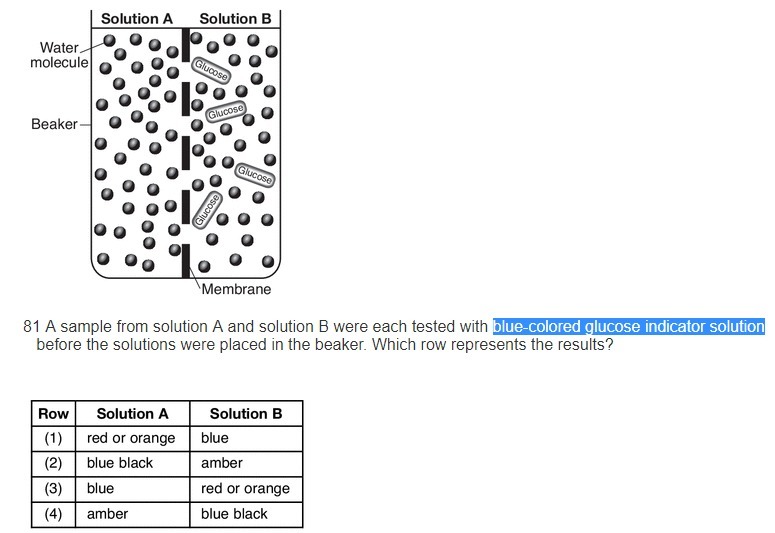
A sample from solution a and solution b were each tested with blue colored glucose indicator solution before the solutions were
vova2212 [387]
With the given problem you gave here, I can't answer the question because I need more details. Luckily, I found a similar problem that's provided with a diagram and a table shown in the attached picture.

This test is called the Benedict's test which is used as test for presence of sugars. If the solution contains sugar, like glucose, the solution would turn from blue to red. If not, it would stay blue. <em>Therefore, the correct results would be that in row 3.</em>

3 0
2 years ago
Equimolar samples of CH3OH(l) and C2H5OH(l) are placed in separate, previously evacuated, rigid 2.0 L vessels. Each vessel is at
UkoKoshka [18]

Answer:

Complete Question:  

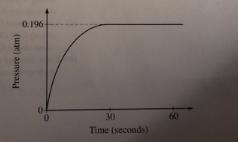
Equimolar samples of CH3OH(l) and C2H5OH(l) are placed in separate, previously evacuated, rigid 2.0 L vessels. Each vessel is attached to a pressure gauge, and the temperatures are kept at 300 K. In both vessels, liquid is observed to remain present at the bottom of the container at all times. The change in pressure inside the vessel containing CH3OH(l) is shown below.

Compared to the equilibrium vapor pressure of CH3OH(l) at 300 K, the equilibrium vapor pressure of C2H5OH(l) at 300 K is

ANSWER : lower, because London dispersion forces among C2H5OH molecules are greater than those among CH3OH molecules

Explanation:

In Order to get a good understanding the answer above let first define some terms

The London dispersion force is the weakest inter-molecular force. The London dispersion force is a temporary attractive force that results when the electrons in two adjacent atoms occupy positions that make the atoms form temporary dipoles.  

The vapor pressure of a liquid is the equilibrium pressure of a vapor above its liquid (or solid); that is, the pressure of the vapor resulting from evaporation of a liquid (or solid) above a sample of the liquid (or solid) in a closed container

The pressure will be Lower, because London dispersion forces among C2H5OH molecules are greater than those among CH3OH molecules ,What this means is that the stronger the inter-molecular forces, the stronger the interactions that hold the substance together, hence the lower the vapor pressure of the liquid at a given temperature, and the harder it is to vaporize the  substance.

Note: London dispersion force among C2H5OH molecules is higher than that among CH3OH molecules because the number of electrons in C2H5OH is greater than that in CH3OH.

3 0
2 years ago
The small intestine shown below contains lymphatic vessels but no capillaries. Which nutrient will be absorbed by this small int
Bumek [7]

Answer:

fatty acids

Explanation:

8 0
2 years ago
Read 2 more answers
Other questions:
  • Determine the number of atoms in 1.85 ml of mercury. (the density of mercury is 13.5 g/ml.)
    15·1 answer
  • Consider the following balanced equation: Fe + 2Ag+ Fe2+ + 2Ag Which statement is true?
    12·1 answer
  • Which statement best describes the oxidation numbers of the atoms found in magnesium chloride?
    7·1 answer
  • In parallel flow heat exchangers...
    10·1 answer
  • Calculate the number of grams of Mg needed for this reaction to release enough energy to increase the temperature of 78 mL of wa
    10·1 answer
  • List the salts in order from weakest to strongest lattice energy (most positive to most negative). magnesium chloride, barium ch
    8·1 answer
  • These little bunnies (A, B, and C) were born in the same litter to the same parents, but they have different traits for the feat
    12·1 answer
  • In a laboratory, Carlos places one plate with grape jelly and another plate with cooked brown rice inside an ant farm. The next
    12·2 answers
  • In the synthesis of barium carbonate from an alkali metal carbonate (M2CO3 where M is one of the alkali metals) a student genera
    9·1 answer
  • A higher temperature of fresh concrete results in a __________ hydration of cement.
    11·1 answer
Add answer
Login
Not registered? Fast signup
Signup
Login Signup
Ask question!