answer.
Ask question
Login Signup
Ask question
All categories
  • English
  • Mathematics
  • Social Studies
  • Business
  • History
  • Health
  • Geography
  • Biology
  • Physics
  • Chemistry
  • Computers and Technology
  • Arts
  • World Languages
  • Spanish
  • French
  • German
  • Advanced Placement (AP)
  • SAT
  • Medicine
  • Law
  • Engineering
babymother [125]
2 years ago
11

A cliff diver positions herself on a cliff that angles downwards towards the edge. The length of the top of the cliff is 50.0 m

and the angle of the cliff is θ = 21.0° below the horizontal. The cliff diver runs towards the edge of the cliff with a constant speed, and reaches the edge of the cliff in a time of 6.10 s. After running straight off the edge of the cliff (without jumping up), the diver falls h = 30.0 m before hitting the water.
After leaving the edge of the cliff how much time does the diver take to get to the water?


How far horizontally does the diver travel from the cliff face before hitting the water?


Remember that the angle is at a downward slope to the right.

Physics
1 answer:
solong [7]2 years ago
4 0

Answer:

After leaving the edge, it takes the diver 2.79 s to reach the water.

She travels 21.4 m horizontally from the cliff.

Explanation:

Hi there!

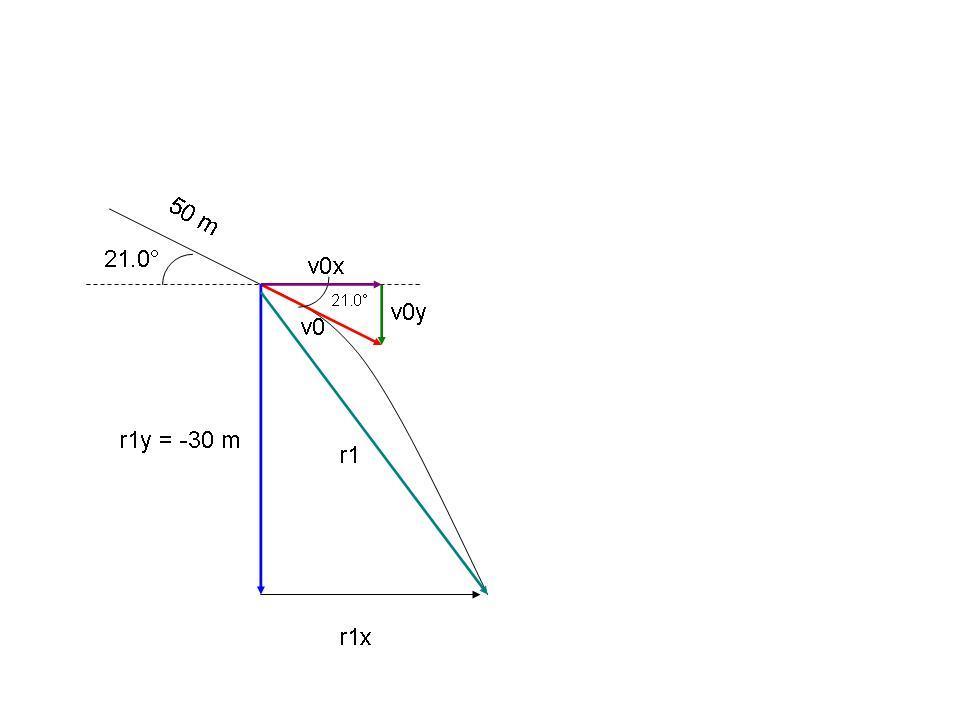
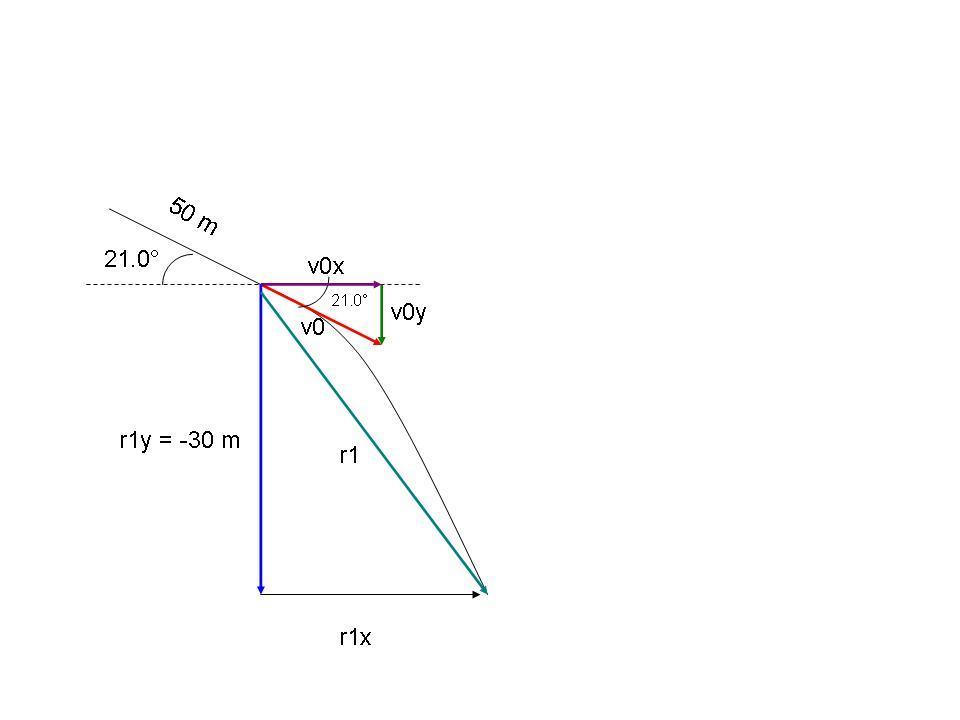
Please, see the attached figure for a graphical description of the problem.

The equation of the position vector of the diver at time t is the following:

r = (x0 + v0 · t · cos θ, y0 + v0 · t · sin θ + 1/2 · g · t²)

Where:

r = position vector at time t.

x0 = initial horizontal position.

v0 = initial velocity.

t = time.

θ = angle of falling.

y0 = initial vertical position.

g = acceleration due to gravity (-9.8 m/s²).

If we place the origin of the frame of reference at the top of the cliff on the edge, then x0 and y0 are equal to zero (initial position r0 = (0, 0)).

First, let's calculate the initial velocity of the diver knowing that she traveled 50.0 m in 6.10 s at constant speed:

v = d/t

where:

v = speed.

x = traveled distance.

t = time.

v = 50.0 m/ 6.10 s

v = 8.20 m/s

The initial velocity is 8.20 m/s.

We know that the vertical component of the position vector at the time when the diver hits the water is -30.0 m (see r1y in the figure). Then, using the equation of vertical position we can calculate the time it takes the diver to reach the water:

y = y0 + v0 · t · sin θ + 1/2 · g · t²    (y0 = 0)

-30.0 m = 8.20 m/s · sin (21.0°) · t - 1/2 · 9.8 m/s² · t²

0 = 30.0 m + 8.20 m/s · sin (21.0°) · t - 4.9 m/s² · t²

Solving the quadratic equation:

t = 2.79 s (the other solution is rejected because it is negative).

After leaving the edge, it takes the diver 2.79 s to reach the water.

Now, let's use the equation of the horizontal position and find the horizontal distance traveled in 2.79 s:

x = x0 + v0 · t · cos θ    (x0 = 0)

x = 8.20 m/s · 2.79 s · cos (21.0°)

x = 21.4 m

She travels 21.4 m horizontally from the cliff.
You might be interested in
The surface pressures at the bases of warm and cold columns of air are equal. air pressure in the warm column of air will ______
EastWind [94]
In atmospheric science, surface pressure<span> is the atmospheric </span>pressure<span> at a location on Earth's </span>surface<span>. It is directly proportional to the mass of air over that location. For numerical reasons, atmospheric models such as general circulation models (GCMs) usually predict the nondimensional logarithm of </span>surface pressure<span>.

The answer is decrease more slowly


</span>
3 0
2 years ago
A starship passes Earth at 80% of the speed of light and sends a drone ship forward at half the speed of light rela- tive to its
alisha [4.7K]

Answer:

Check Explanation

Explanation:

Let the speed of the drone relative to earth be u = ?

Let the speed of the drone relative to the starship be u' = 0.5c

Let the speed of the starship relative to earth be v = 0.8c

In the theory of relativity,

The 3 speeds are related thus

u = (u' + v)/[1 + (u'v/c²)]

u = (0.5c + 0.8c)[1 + ((0.8c × 0.5c)/c²)]

u = 1.3c/[1 + (0.4c²/c²)]

u = 1.3c/1.4 = 0.9286 c = 0.93 c = 93% c

8 0
2 years ago
What force must be exerted on the master cylinder of a hydraulic lift to support the weight of a 2000-kg car (a large car) resti
Nataliya [291]

Archimedes principle states that


F1 / A1 = F2 / A2

F2 = (A2 / A1) * F1


Also, formula for the force is F = mg. Formula for the area of the cylinder is A = πr^2, therefore we get


F2 = (πr2^2 / πr1^2) * mg


Since the diameter of the cylinders are 2 cm and 24 cm, r1 = 12 and r2 = 1.


Substituting the values to the derived equation, we get


F2 = (π 1^2 / π 12^2) * 2400 * 9.8

F2 = 163.3333 N


<span> </span>

6 0
2 years ago
Object A with a mass of 500 kilograms hits stationary object B with a mass of 920 kilograms. If the collision is elastic, what h
Vika [28.1K]
In elastic collision, both the kinetic energy and momentum are conserved. Conservation means that both the kinetic energy and momentum will have the same values before and after elastic collision.

<span>As the object A has low mass than object B. Hence upon collision, object B moves forward, while object A will move backward. So option "C" is correct. </span>

5 0
2 years ago
Draw the vector C⃗ =1.5A⃗ −3B⃗ . The length and orientation of the vector will be graded. The location of the vector is not impo
Nutka1998 [239]
I made the drawing in the attached file.

I included two figures.

The upper figure shows the effect of:

- multiplying vector A times 1.5.
 It is drawn in red with dotted line.

- multiplying vector B times - 3 .
It is drawn in purple with dotted line.

In the lower figure you have the resultant vector: C = 1.5A - 3B.

The method is that you translate the tail of the vector -3B unitl the point of the vector 1,5A, preserving the angles.

Then you draw the arrow that joins the tail of 1,5A with the point of -3B after translation.

The resultant arrow is the vector C and it is drawn in black dotted line.
 
Download pdf
7 0
2 years ago
Read 2 more answers
Other questions:
  • A 1938 nickel has a diameter of 21.21 mm, a thickness of 1.95 mm, and weighs 0.04905 N. What is its density?
    13·1 answer
  • Consider a solid, rigid spherical shell with a thickness of 100 m and a density of 3900 kg/m3 . the sphere is centered around th
    5·2 answers
  • A 5.0 kg cannonball is dropped from the top of a tower. It falls for 1.6 seconds before slamming into a sand pile at the base of
    8·1 answer
  • A weather balloon is filled to a volume of 6000 L while it is on the ground, at a pressure of 1 atm and a temperature
    11·2 answers
  • Two 7.0cm×7.0cm metal electrodes are spaced 1.0 mm apart and connected by wires to the terminals of a 9.0 v battery.
    9·1 answer
  • Calculate the partial pressure of ozone at 441 ppb if the atmospheric pressure is 0.67 atm.
    6·1 answer
  • Loss of traction between the rear wheels and road surfaces like ice, sand, or gravel results in what is called _______________.
    8·1 answer
  • Alicia intends to swim to a point straight across a 100 m wide river with a current that flows at 1.2 m/s. She can swim 2.5 m/s
    12·1 answer
  • CHEGG 42 mT magnetic field points due west. If a proton of kinetic energy 9 x 10-12 J enters this field in an upward direction,
    15·1 answer
  • A train runs from New Delhi to Hyderabad it covers first of 420 km in 7 hours and the next distance of 360 km in 6 hours​
    10·2 answers
Add answer
Login
Not registered? Fast signup
Signup
Login Signup
Ask question!