answer.
Ask question
Login Signup
Ask question
All categories
  • English
  • Mathematics
  • Social Studies
  • Business
  • History
  • Health
  • Geography
  • Biology
  • Physics
  • Chemistry
  • Computers and Technology
  • Arts
  • World Languages
  • Spanish
  • French
  • German
  • Advanced Placement (AP)
  • SAT
  • Medicine
  • Law
  • Engineering
Savatey [412]
2 years ago
4

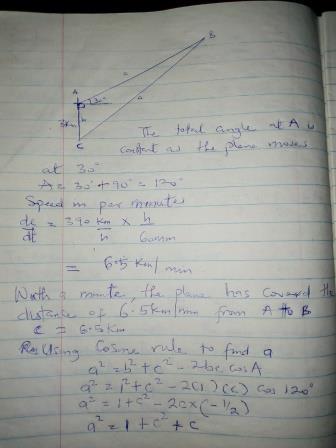
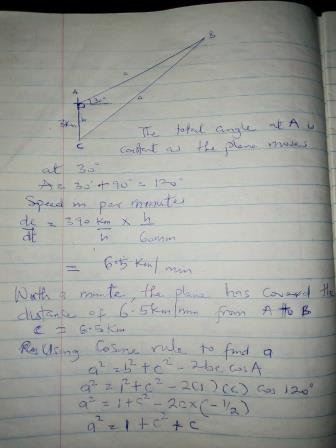
A plane flying with a constant speed of 390 km/h passes over a ground radar station at an altitude of 3 km and climbs at an angl

e of 30°. At what rate is the distance from the plane to the radar station increasing a minute later? (Round your answer to the nearest whole number.) 325 Incorrect: Your answer is incorrect. km/h

Physics
2 answers:
cricket20 [7]2 years ago
4 0

Answer: 387.23 km/hr

Explanation:

jok3333 [9.3K]2 years ago
3 0

Answer:

The answer to the question is;

One minute later the distance from the plane to the radar station is increasing at a rate of 387.049 kph

Explanation:

Spped of plane = 390 km/h = 108.3 m/s

angle of 30 degrees vertical component of velocity = 390 * sin 30 = 195 km/h = 6.45 km/min

after one minute we have

6.45 km

Using cosine rule we have

a^2=b^2+c^2-2bc cosA

Where A = 120 and

b = Vertical height of plane above radar = 1 km

a = Distance of plane from radar

c = Distance moved by plane in one minute = third side of triangle abc

Solving with b = 1 kph gives

a^2=1^2+c^2-2bc cos(120)

= 1 + c^2-2×1×c ×(-1/2)

=1+c^2+c or

a² = 1 + c² + c

Where c = 6.5 a =7.0533

To find the rate of change of a with time, we have

2a(da/dt)=0+2c(dc/dt)+dc/dt

(da/dt) = (2c+1)(dc/dt)/(2a)

Which gives

(da/dt)= (2×6.5+1)×6.5÷(2×7.0533)

= 6.45km/min

Multiply by 60 min/hour, we have

6.45km/min×60 min/hour

=387.049 kph
You might be interested in
A mercury thermometer has a glass bulb of interior volume 0.100 cm3 at 10°c. the glass capillary 10) tube above the bulb has an
Nadya [2.5K]
Initial volume of mercury is
V = 0.1 cm³

The temperature rise is 35 - 5 = 30 ⁰C = 30 ⁰K.

Because the coefficient of volume expansion is 1.8x10⁻⁴ 1/K, the change in volume of the mercury is 
ΔV = (1.8x10⁻⁴ 1/K)*(30 ⁰K)(0.1 cm³) = 5.4x10⁻⁴ cm³

The cross sectional area of the tube is
A = 0.012 mm² = (0.012x10⁻² cm²).
Therefore the rise of mercury in the tube is
h = ΔV/A
   = (5.4x10⁻⁴ cm³)/(0.012x10⁻² cm²)
   = 4.5 cm

Answer: 4.5 cm
7 0
2 years ago
Read 2 more answers
While looking at bromine (Br) on the periodic table, a student needs to find another element with very similar chemical properti
Ede4ka [16]

Answer: There are many possible elements, and they are all in the same vertical column as bromine.

Explanation:

In a periodic table, the elements are arranged according to the atomic number. The elements arranged in the same vertical column (known as groups) have same valence configuration and therefore have same chemical properties. Hence, there would be more possible elements having same chemical properties in the same vertical column (group) as Bromine.

7 0
2 years ago
Read 2 more answers
Four electrons are located at the corners of a square 10.0 nm on a side, with an alpha particle at its midpoint. How much work i
Elis [28]

Four electrons are placed at the corner of a square

So we will first find the electrostatic potential at the center of the square

So here it is given as

V = 4\frac{kQ}{r}

here

r = distance of corner of the square from it center

r = \frac{a}{\sqrt2}

r = \frac{10nm}{\sqrt2} = 7.07 nm

Q = e = -1.6 * 10^{-19} C

now the net potential is given as

V = \frac{4 * 9*10^9 * (-1.6 * 10^{-19})}{7.07 * 10^{-9}}

V = 0.815 V

now potential energy of alpha particle at this position

U_i = qV = 2*1.6 * 10^{-19} * (-0.815) = -2.6 * 10^{-19} J

Now at the mid point of one of the side

Electrostatic potential is given as

V = 2\frac{kQ}{r_1} + 2\frac{kQ}{r_2}

here we know that

r_1 = \frac{a}{2} = 5 nm

r_2 = \sqrt{(a/2)^2 + a^2} = \frac{\sqrt5 a}{2}

r_2 = 11.2 nm

now potential is given as

V = 2\frac{9 * 10^9 * (-1.6 * 10^{-19})}{5 * 10^{-9}} + 2\frac{9*10^9 * (-1.6 * 10^{-19})}{11.2 * 10^{-9}}

V = -0.576 - 0.257 = -0.833 V

now final potential energy is given as

U_f = q*V = 2*1.6 * 10^{-19}* (-0.833) = -2.67 * 10^{-19} J

Now work done in this process is given as

W = U_f - U_i

W = (-0.267 * 10^{-19}) - (-0.26 * 10^{-19}}

W = -7 * 10^{-22} J

8 0
2 years ago
What is Otter's average velocity over his entire trip when it takes him 2 minutes to walk 100 meters north and another 1 minute
Leya [2.2K]

Answer:

0.50m/s

Explanation:

Average velocity is the change in displacement of a body with respect to time.

Velocity = ∆S/∆t

∆S = 100m - 70m

∆S = 30m

∆t = 2min - 1 min

∆t = 1min = 60secs

Substitute the given parameters into the formula for velocity

Velocity = 30m/60s

Velocity = 1/2 m/s

Average Velocity = 0.5m/s

7 0
2 years ago
Springfield's "classic rock" radio station broadcasts at a frequency of 102.1 mhz. what is the length of the radio wave in meter
Mila [183]
The frequency of the radio wave is:
f=102.1 MHz = 102.1 \cdot 10^6 Hz

The wavelength of an electromagnetic wave is related to its frequency by the relationship
\lambda= \frac{c}{f}
where c is the speed of light and f the frequency. Plugging numbers into the equation, we find
\lambda= \frac{3 \cdot 10^8 m/s}{102.1 \cdot 10^6 Hz}= 2.94 m
and this is the wavelength of the radio waves in the problem.
7 0
2 years ago
Other questions:
  • Isabella drops a pen off her balcony by accident while celebrating the successful completion of a physics problem. assuming air
    6·1 answer
  • Darryl throws a basketball at the gym floor.The ball bounces once on the floor comes to rest in his coach's hands.At which point
    12·2 answers
  • A circular surface with a radius of 0.057 m is exposed to a uniform external electric field of magnitude 1.44 × 10⁴ N/C. The mag
    8·1 answer
  • A 2 kg object released from rest at the top of a tall cliff reaches a terminal speed of 37.5 m/s after it has fallen a height of
    13·1 answer
  • A cliff diver on an alien planet dives off of a 32 meter tall cliff and lands in a sea of hydrochloric acid 1.20 seconds later.
    11·1 answer
  • A uniform rod of mass M and length L is free to swing back and forth by pivoting a distance x from its center. It undergoes harm
    14·1 answer
  • A horizontal water jet strikes a stationary vertical plate at a rate of 5 kg/s with a velocity of 35 km/hr. Assume that the wate
    15·1 answer
  • A water wave traveling in a straight line on a lake is described by the equation:y(x,t)=(2.75cm)cos(0.410rad/cm x+6.20rad/s t)Wh
    11·1 answer
  • As computer structures get smaller and smaller, quantum rules start to create difficulties. Suppose electrons move through a cha
    11·1 answer
  • A point charge of -3.0 x 10-C is placed at the origin of coordinates. Find the clectric field at the point 13. X= 5.0 m on the x
    8·1 answer
Add answer
Login
Not registered? Fast signup
Signup
Login Signup
Ask question!