answer.
Ask question
Login Signup
Ask question
All categories
  • English
  • Mathematics
  • Social Studies
  • Business
  • History
  • Health
  • Geography
  • Biology
  • Physics
  • Chemistry
  • Computers and Technology
  • Arts
  • World Languages
  • Spanish
  • French
  • German
  • Advanced Placement (AP)
  • SAT
  • Medicine
  • Law
  • Engineering
Monica [59]
2 years ago
3

The normal modes of this system are products of trigonometric functions. (For linear systems, the time dependance of a normal mo

de is always sinusoidal, but the spatial dependence need not be.) Specifically, for this system a normal mode is described by
yi(x,t)=Ai sin(2p*x/?i)sin(2pfi*t)

Find the three lowest normal mode frequencies f1, f2, and f3.
Express the frequencies in terms of L, v, and any constants. List them in increasing order, separated by commas

Physics
1 answer:
mario62 [17]2 years ago
4 0

Answer:

The normal modes of this system are products of trigonometric functions. (For linear systems, the time dependency of a normal mode is always sinusoidal, but the spatial dependence need not be.) Specifically, for this system a normal mode is described by

y(x,t)=A sin[2πx/λ] sin[(2πf)t]

Find the three lowest normal mode frequencies f1, f2, and f3.

Express the frequencies in terms of L, v, and any constants. List them in increasing order, separated by commas

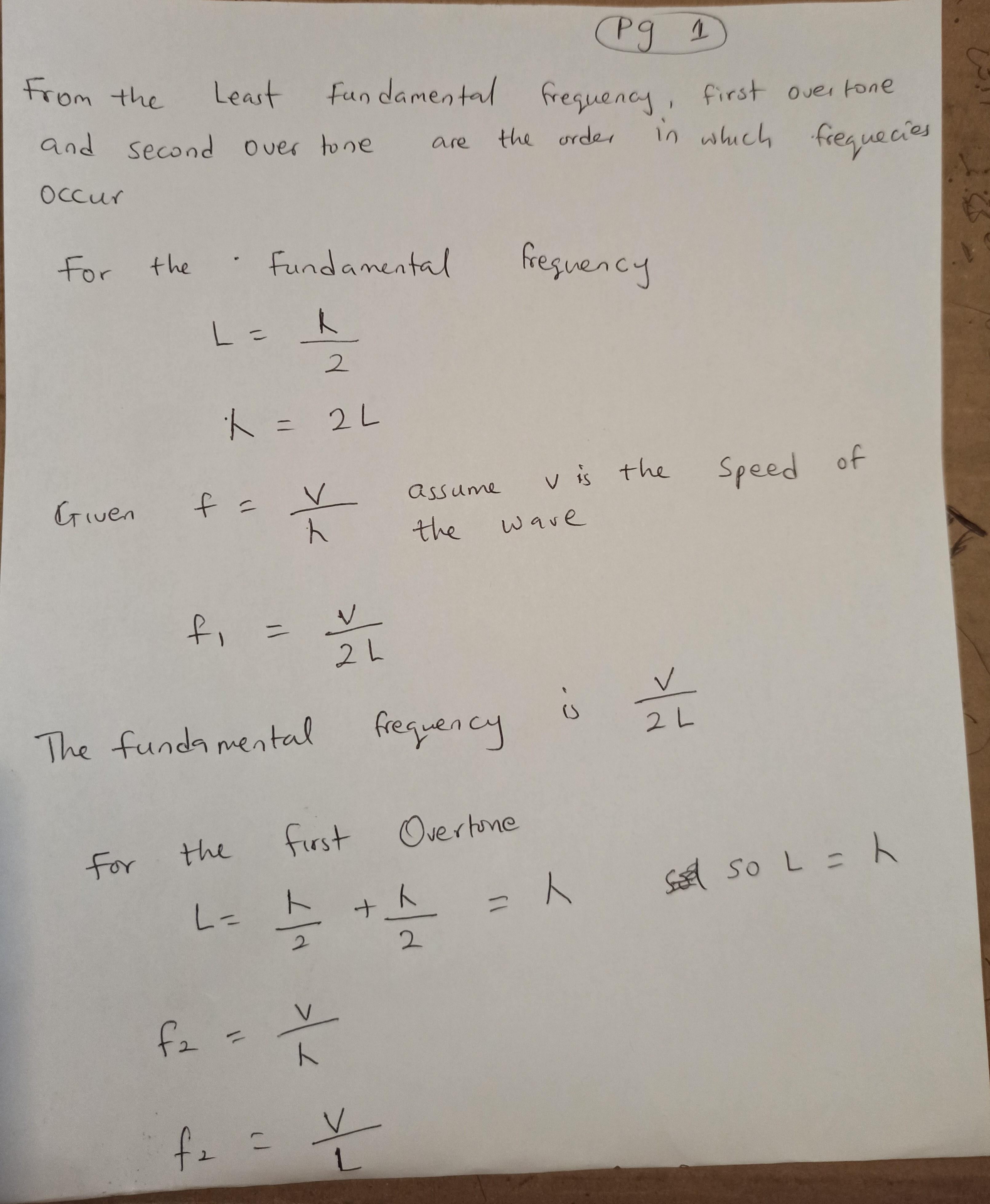
In order of increasing frequencies we have f_{1}, f_{2} , f_{3}

f_{1}= \frac{v}{2L}  \\f_{2} = \frac{v}{L} \\f_{3} = \frac{3v}{2L}

Explanation:

The attached images are  step by step calculation to the question, we are to obtain the fundamental frequency, the first overtone and second overtone;  
You might be interested in
Consider two waves defined by the wave functions y1(x,t)=0.50msin(2π3.00mx+2π4.00st) and y2(x,t)=0.50msin(2π6.00mx−2π4.00st). Wh
guapka [62]

Answer:

They two waves has the same amplitude and frequency but different wavelengths.

Explanation: comparing the wave equation above with the general wave equation

y(x,t) = Asin(2Πft + 2Πx/¶)

Let ¶ be the wavelength

A is the amplitude

f is the frequency

t is the time

They two waves has the same amplitude and frequency but different wavelengths.

4 0
2 years ago
Two electric force vectors act on a particle. Their x-components are 13.5 N and −7.40 N and their y-components are −12.0 N and −
guapka [62]

Answer:

Explanation:

Given two vectors as follows

E₁ = 13.5 i -12 j

E₂ = -7.4 i - 4.7 j

Resultant E = E₁ + E₂

= 13.5 i -12 j -7.4 i - 4.7 j

E = 6.1 i - 16.7 j

a ) X component of resultant = 6.1 N

b ) y component of resultant = -16.7 N

Magnitude of resultant = √ ( 6.1² + 16.7² )

= 17.75 N

d ) If θ be the required angle

tanθ = 16.7 / 6.1 = 2.73

θ = 70° .

counterclockwise = 360 - 70 = 290°

6 0
2 years ago
A person's height will increase from birth until about age 25, and it may decrease starting at about age 70. This is an example
dsp73
LOL idk sorry maybe it b! Oh wait it is !
5 0
2 years ago
Read 2 more answers
A scientist places a strip of hot metal on top of a block of another metal with a lower melting point. The second metal quickly
gayaneshka [121]

Answer:

D:

Explanation:

Conduction because the heat energy is transferring directly from the separate metals convection involves "currents" like in a liquid or a gas. When you turn on the stove with a pot of water on the burner the water at the bottom of the pot gets heated first almost immediately this water rises and cooler water falls. Basically the water is "stirring" or shifting, exchanging the heat energy this is why water heats so evenly.

4 0
2 years ago
When 0.1523 g of liquid pentane (CH) combusts in a bomb calorimeter, the temperature rises from 23.7C to 29.8 C. What is U for t
pashok25 [27]

Answer:

U for the reaction is 15,048.58 kJ/mol of pentane.

Explanation:

Quantity of heat required = heat capacity of bomb calorimeter × temperature rise = 5.23 kJ/C × (29.8 C - 23.7 C) = 5.23 kJ/C × 6.1 C = 31.903 kJ

Moles of pentane = mass/MW

Mass = 0.1523 g

MW of pentane (C5H12) = 72 g/mol

Moles of pentane = 0.1523/72 = 0.00212 mol

U for the reaction = quantity of heat required ÷ moles of pentane = 31.903 kJ ÷ 0.00212 mol = 15,048.58 kJ/mol

8 0
2 years ago
Other questions:
  • Two planets having equal masses are in circular orbit around a star. Planet A has a smaller orbital radius than planet B. Which
    7·1 answer
  • A straight wire 20 cm long, carrying a current of 4 A, is in a uniform magnetic field of 0.6 T. What is the force on the wire wh
    15·2 answers
  • A hydrogen atom contains a single electron that moves in a circular orbit about a single proton. Assume the proton is stationary
    8·1 answer
  • A girl at an airport rolls a ball north on a moving walking that moves east. If the ball’s speed with respect to the walkway is
    5·1 answer
  • In a fusion reaction, the nuclei of two atoms join to form a single atom of a different element. In such a reaction, a fraction
    5·1 answer
  • A 2200 kg truck has put its front bumper against the rear bumper of a 2400 kg SUV to give it a push. With the engine at full pow
    6·1 answer
  • A meteoroid, heading straight for Earth, has a speed of 14.8 km/s relative to the center of Earth as it crosses our moon's orbit
    5·1 answer
  • A parallel plate capacitor stores charge, and thus, stores energy in the form of electric potential energy. The total energy sto
    9·1 answer
  • A balloon tied up with a wooden piece is moving upward with velocity of 15m/s. At a height of 300m above the ground, the wooden
    10·1 answer
  • A substance occupies one half of an open container. The atoms of the substance are closely packed but are still able to slide pa
    6·1 answer
Add answer
Login
Not registered? Fast signup
Signup
Login Signup
Ask question!