answer.
Ask question
Login Signup
Ask question
All categories
  • English
  • Mathematics
  • Social Studies
  • Business
  • History
  • Health
  • Geography
  • Biology
  • Physics
  • Chemistry
  • Computers and Technology
  • Arts
  • World Languages
  • Spanish
  • French
  • German
  • Advanced Placement (AP)
  • SAT
  • Medicine
  • Law
  • Engineering
iogann1982 [59]
2 years ago
7

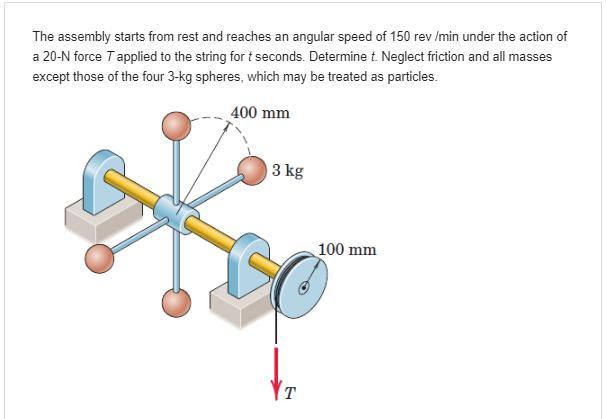
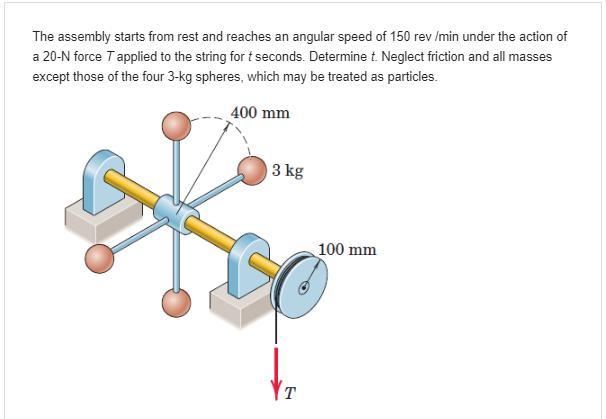
[1] The assembly starts from rest and reaches an angular speed of 150 rev/min under the action of a 20-N force T applied to the

staring for t seconds. Determine t. Neglect friction and all masses except those of the four 3-kg spheres, which may be treated as particles.

Physics
2 answers:
ExtremeBDS [4]2 years ago
7 0

Answer:

t = 5.89 s

Explanation:

To calculate the time, we need the radius of the pulley and the radius of the sphere which was not given in the question.

Let us assume that the radius of the pulley (r_p) = 0.4 m

Let the radius of the sphere (r) = 0.5 m

w = angular speed = 150 rev/min = (150 × 2π / 60) rad/s = 15.708 rad/s

Tension (T) = 20 N

mass (m) = 3 kg each

\int\limits^0_t {Tr_p} \, dt=H_2-H_1\\( Tr_p)t=4rm(rw)\\( Tr_p)t=4r^2mw

t = \frac{4r^2mw}{Tr_P}

Substituting values:

t = \frac{4r^2mw}{Tr_P}= \frac{4*(0.5)^2*3*15.708}{20*0.4}=5.89s

Lapatulllka [165]2 years ago
7 0

Complete  Question

The complete question is shown on the first uploaded image

Answer:

The value of t is  t = 15.08 \ s

Explanation:

From the question we are told that the angular speed is

         The initial angular speed w_f  = 150 rev/min = \frac{2 \pi }{60s} * 150 = 15.71rad /s

          The force is  T = 20 N

           The radius is r = 400mm = \frac{400}{1000} = 0.4m

             The  total mass of the four sphere is  m_a =  (4*3) = 12kg

             The initial  velocity is v_i = 0m/s

               The  radius of the pully is  r_p = 100mm = \frac{100}{1000} = 0.10m

               The initial time is t_1 = 0s

               The final time is  t = t


Generally the final velocity of the sphere is mathematically represented as

                v_f = r w_f

                v_f=15.7 r

The angular impulse momentum principle can be represented methematically as

                 (H_O)_i + \int\limits^{t_1}_{t_2}{(T \cdot r_{p})} \, dt = (H_O)_f

                r(m_a v_i ) + \int\limits^{t_2}_{t_1} {T \cdot r_p} \, dt = r(m_a v_f)

               r(m_a v_1 ) + T  \cdot r_p (t_{2} -t_{1}) = r( m_a * 15.7 r )

   Substituting values

              0.4 * (12* 0) + (20 *0.10 * (t-0)) = 0.40 * (12* 0.40 *15.7)

     =>      0 + 2t = 30.16

     =>     t = 15.08 \ s


You might be interested in
Light from a lamp is shining on a surface. how can you increase the intensity of the light on the surface?
vlada-n [284]
The intensity of a light in a surface follows the inverse square law formula which can be mathematically expressed as,
                         I = k/d²
where I is intensity, d is distance, and k is the proportionality constant. For us to increase the intensity, we should lower the distance from the source to the surface. 
4 0
2 years ago
An astronaut hits a golf ball of mass m on the Moon, where there is no atmosphere and the acceleration due to gravity is g 6 , w
sasho [114]

Answer:

The magnitude of the average force exerted by the club on the ball during contact = mv/t

Explanation:

Impulse exerted on the ball = Momentum of the ball = mass * velocity = m*v

As we know,  

m*v = Integration of F.dt with limits 0 to T

Ft = mv

F = mv/t

The magnitude of the average force exerted by the club on the ball during contact = mv/t

5 0
2 years ago
A physics student stands on the rim of the canyon and drops a rock. The student measures the time for it to reach the bottom to
madam [21]

Answer:

Canyon is 50.176 meter deep.

Explanation:

The students is standing on the rim of the canyon and drops down a rock from the rim(cliff). We have to find what is the depth of the canyon i.e. how much below is the ground from the cliff.

Given data:

Time = t = 3.2 s

Initial velocity = v_{i} = 0 m/s

Gravitational acceleration = g = 9.8 m/s²

Height = h = ?

According to second equation of motion

h = v_{i}t + \frac{1}{2}gt^{2}

As initial velocity is zero, So the first term of right hand side of above equation equal to zero

h = \frac{1}{2}gt^{2}

h = (0.5)(9.8)(3.2)²

h = 50.176 m

This means, the rock traveled 50.176 meters to reach the bottom of the Canyon. So, the Canyon is 50.176 meter deep.

5 0
2 years ago
You are pulling your little sister on her sled across an icy (frictionless) surface. When you exert a constant horizontal force
Tpy6a [65]

Answer:

Mass of Little Sister = 44.17 kg

Explanation:

From Newton's second law of motion, the magnitude of force applied on the sled is given by the following formula:

F = ma

where,

F = Force Applied = 120 N

a = Acceleration = 2.3 m/s²

m = Mass of Sled + Mass of Little Sister = 8 kg + Mass of Little Sister

Therefore,

120 N = (2.3 m/s²)(8 kg + Mass of Little Sister)

(120 N)/(2.3 m/s²) = 8 kg + Mass of Little Sister

Mass of Little Sister = 52.17 kg - 8 kg

<u>Mass of Little Sister = 44.17 kg</u>

4 0
2 years ago
Upon impact, bicycle helmets compress, thus lowering the potentially dangerous acceleration experienced by the head. A new kind
Dimas [21]

Answer:

acceleration = -15.3g

Explanation:

given data

speed = 6.00 m/s.

thickness = 12

moves the entire = 12.0 cm

solution

we will use here equation that is

v² - u²  = 2 × a × s    ........................1

here v = 0 is the final velocity and u = 6.0 m/s is initial velocity and s= 0.12 m is the distance covered and a is the acceleration

so we put here value and get acceleration

a = \frac{v^2-u^2}{2s}

a = \frac{0^2-6^2}{2\times 0.12}

a = -150 m/s² ( negative sign means it is a deceleration )

and

acceleration in units of g  

a = \frac{-150}{9.8}

a = -15.3 g

6 0
2 years ago
Other questions:
  • a bobsled has a momentum of 1500 kg*m/s to the south. Air resistance reduces its momentum to 750 kg*m/s to the south. What impul
    11·2 answers
  • As Aubrey watches this merry-go-round for a total of 2 minutes, she notices the black horse pass by 15 times. What is the period
    12·2 answers
  • About three billion years ago, single-celled organisms called cyanobacteria lived in Earth’s oceans. They thrived on the ocean’s
    12·2 answers
  • A point charge q1=−4.00nc is at the point x=0.600 meters, y=0.800 meters, and a second point charge q2=+6.00nc is at the point x
    11·2 answers
  • Mantles for gas lanterns contain thorium, because it forms an oxide that can survive being heated to incandescence for long peri
    8·1 answer
  • Astronomers determine that a certain square region in interstellar space has an area of approximately 2.4 \times 10^72.4×10 ​7 ​
    7·1 answer
  • Identical guns fire identical bullets horizontally at the same speed from the same height above level planes, one on the Earth a
    7·1 answer
  • The circuit below represents four resistors connected to a 12-volt source. What is the total current in the circuit? 4.0Ω 6.0Ω 1
    11·2 answers
  • The cantilever beam AB has a rectangular cross section of 150 × 200 mm. Knowing that the tension in the cable BD is 10.8 kN and
    8·1 answer
  • A light bulb in a battery powered desk lamp has a current of 0.042 A and is connected to a 9.2 V battery. What is the resistance
    9·2 answers
Add answer
Login
Not registered? Fast signup
Signup
Login Signup
Ask question!