answer.
Ask question
Login Signup
Ask question
All categories
  • English
  • Mathematics
  • Social Studies
  • Business
  • History
  • Health
  • Geography
  • Biology
  • Physics
  • Chemistry
  • Computers and Technology
  • Arts
  • World Languages
  • Spanish
  • French
  • German
  • Advanced Placement (AP)
  • SAT
  • Medicine
  • Law
  • Engineering
vlabodo [156]
1 year ago
7

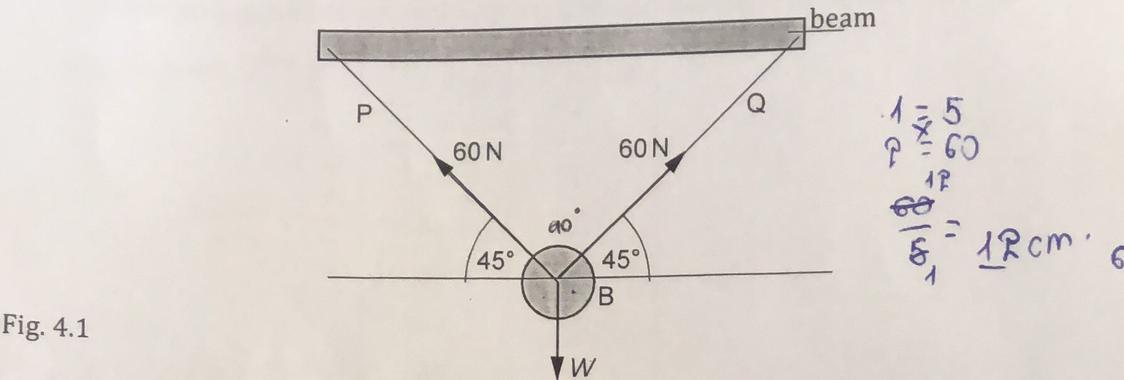
8. Fig. 4.1 shows a heavy ball B of weight W suspended from a fixed beam by two ropes P and Q.

Physics
1 answer:
Serhud [2]1 year ago
6 0

Answer:

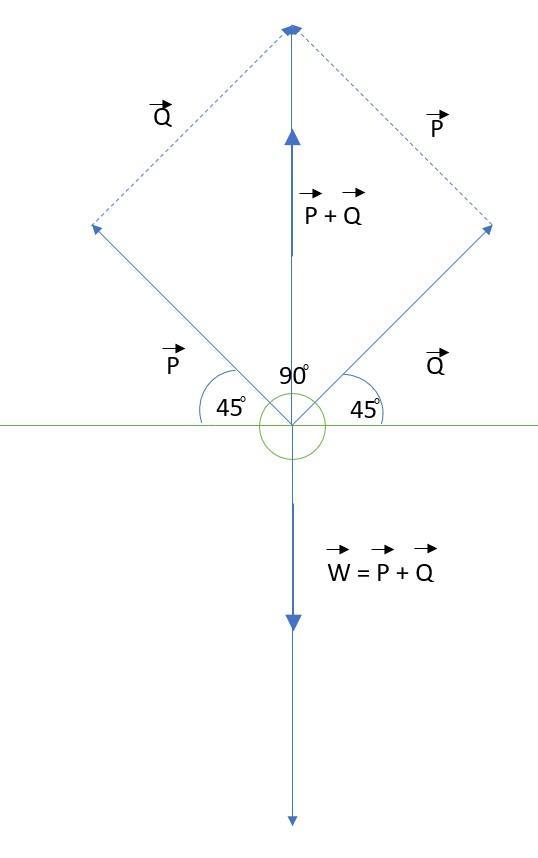
a. Please find attached the required scale diagram drawn to scale using Microsoft Word

The resultant tension, R = W = 42.415 N

Explanation:

The given parameters are;

The angle P and Q makes with the horizontal = 45°

The tensions in the ropes P and Q = 30 N each

The weight of the heavy ball B suspended from the fixed beam by the ropes = W

The scale drawing is drawn using Microsoft Word

The required scale factor of the scale diagram, S.F. = 5.0 N/cm

Therefore, we have;

The length of the line representing the tensions P and Q = 30 N/(5.0 N/cm) = 6 cm

The length of the resultant vector, R = \underset{P}{\rightarrow} + \underset{Q}{\rightarrow}

By the parallelogram law of vector addition, by measurement, we have;

R = 8.483 cm

By conversion using the scale factor of the scale drawing, we have;

R = R × S.F. = 8.483 cm × 5.0 N/cm = 42.415 N

∴ The resultant in the tensions, R = \underset{P}{\rightarrow} + \underset{Q}{\rightarrow} = 42.415.

You might be interested in
A bottle lying on the windowsill falls off and takes 4.95 seconds to reach the ground. The distance from the windowsill to the g
Liula [17]
The distance an object falls from rest through gravity is 
                        D  =  (1/2) (g) (t²) 
           Distance  =  (1/2 acceleration of gravity) x (square of the falling time)

We want to see how the time will be affected 
if  ' D ' doesn't change but ' g ' does. 
So I'm going to start by rearranging the equation
to solve for ' t '.                                                      D  =  (1/2) (g) (t²)

Multiply each side by  2 :         2 D  =            g    t²  

Divide each side by ' g ' :      2 D/g =                  t² 

Square root each side:        t = √ (2D/g)

Looking at the equation now, we can see what happens to ' t ' when only ' g ' changes:

  -- ' g ' is in the denominator; so bigger 'g' ==> shorter 't'

                                             and smaller 'g' ==> longer 't' .-- 

They don't change by the same factor, because  1/g  is inside the square root.  So 't' changes the same amount as  √1/g  does.

Gravity on the surface of the moon is roughly  1/6  the value of gravity on the surface of the Earth.

So we expect ' t ' to increase by  √6  =  2.45 times.

It would take the same bottle  (2.45 x 4.95) = 12.12 seconds to roll off the same window sill and fall 120 meters down to the surface of the Moon.
5 0
2 years ago
The discovery and characterization of cathode rays was important in the development of the atomic theory because
Viefleur [7K]

Answer:

All matter contained electrons

Explanation:

The discovery and characterization of cathode ray suggested that it was a subatomic particle and cathode ray ( electron) was the first discovered. It immensely became the strong explanatory tool for chemical bond. This can be attributed to  the the ease with which electron move from one atom to the other.  

3 0
2 years ago
A uniformly accelerated car passes three equally spaced traffic signs. The signs are separated by a distance d = 25 m. The car p
DedPeter [7]

Answer:

a) v_{1}=\frac{x_{2}-x_{1}  }{t_{2}-t_{1}  }=\frac{(2(\frac{25}{3})-\frac{25}{3} )m}{3.9s-1.3s}  =3.2051 \frac{m}{s}

b) v_{2}=\frac{x_{3}-x_{2}  }{t_{3}-t_{2}  }=\frac{(25-2(\frac{25}{3}) )m}{5.5s-3.9s}  =5.2083 \frac{m}{s}

c) a=\frac{v_{2}-v_{1}  }{t_{2}-t_{1}  } =\frac{5.2083m/s-3.2051m/s}{5.5s-3.9s} =1.252 \frac{m}{s^{2} }

Explanation:

<em><u>The knowable variables are </u></em>

d_{t}=25m

t_{1}=1.3 s

t_{2}=3.9 s

t_{3}=5.5 s

Since the three traffic signs are <u>equally spaced</u>, the <u>distance between each sign is \frac{25}{3} m</u>

a) v_{1}=\frac{x_{2}-x_{1}  }{t_{2}-t_{1}  }=\frac{(2(\frac{25}{3})-\frac{25}{3} )m}{3.9s-1.3s}  =3.2051 \frac{m}{s}

b) v_{2}=\frac{x_{3}-x_{2}  }{t_{3}-t_{2}  }=\frac{(25-2(\frac{25}{3}) )m}{5.5s-3.9s}  =5.2083 \frac{m}{s}

Since we know the velocity in two points and the time the car takes to pass the traffic signs

c) a=\frac{v_{2}-v_{1}  }{t_{2}-t_{1}  } =\frac{5.2083m/s-3.2051m/s}{5.5s-3.9s} =1.252 \frac{m}{s^{2} }

6 0
2 years ago
What is the total kinetic energy of a 0.15 kg hockey puck sliding at 0.5 m/s and rotating about its center at 8.4 rad/s? The dia
ycow [4]
The mass of the puck is
m = 0.15 kg.
The diameter of the puck is 0.076 m, therefore its radius  is
r = 0.076/2 = 0.038 m
The sliding speed is
v = 0.5 m/s
The angular velocity is
ω = 8.4 rad/s

The rotational moment of inertia of the puck is
I = (mr²)/2
  = 0.5*(0.15 kg)*(0.038 m)²
  = 1.083 x 10⁻⁴ kg-m²

The kinetic energy of the puck is the sum of the translational and rotational kinetic energy.
The translational KE is
KE₁ = (1/2)*m*v²
       = 0.5*(0.15 kg)*(0.5 m/s)²
       = 0.0187 j

The rotational KE is
KE₂ = (1/2)*I*ω²
       = 0.5*(1.083 x 10⁻⁴ kg-m²)*(8.4 rad/s)²
       = 0.0038 J

The total KE is
KE = 0.0187 + 0.0038 = 0.0226 J

Answer: 0.0226 J


4 0
2 years ago
In Paul Hewitt's book, he poses this question: "If the forces that act on a bullet and the recoiling gun from which it is fired
Sauron [17]
They have different accelerations because of their masses. According to Newton's Second Law, an objects acceleration is inversely proportional to its mass. Therefore the object with the larger mass, in this case the gun, will have a smaller acceleration. In the same way, the less massive object, being the bullet, will have a higher acceleration.

Hope this helps :)
4 0
2 years ago
Other questions:
  • Calculate the amount of energy produced in a nuclear reaction in which the mass defect is 0.187456 amu.
    13·2 answers
  • What factors might affect how the watermill works?
    14·2 answers
  • Tyson throws a shot put ball weighing 7.26 kg. At a height of 2.1 m above the ground, the mechanical energy of the ball is 172.1
    15·2 answers
  • Suppose you have a pendulum clock which keeps correct time on Earth(acceleration due to gravity = 1.6 m/s2). For ever hour inter
    8·1 answer
  • A 15-g bullet moving at 300 m/s passes through a 2.0 cm thick sheet of foam plastic and emerges with a speed of 90 m/s. Let's as
    14·1 answer
  • An object initially at rest experiences a constant horizontal acceleration due to the action of a resultant force applied for 10
    15·1 answer
  • Two golf carts have horns that emit sound with a frequency of 394 Hz. The golf carts are traveling toward one another, each trav
    7·1 answer
  • Unit of work is derived unit why​
    7·1 answer
  • Emir is standing in a treehouse and looking down at a swingset in the yard next door. The angle of depression from Emir's eyelin
    10·2 answers
  • (a) On the axes below, sketch the graphs of the horizontal and vertical components of the sphere’s velocity as a function of tim
    8·1 answer
Add answer
Login
Not registered? Fast signup
Signup
Login Signup
Ask question!