answer.
Ask question
Login Signup
Ask question
All categories
  • English
  • Mathematics
  • Social Studies
  • Business
  • History
  • Health
  • Geography
  • Biology
  • Physics
  • Chemistry
  • Computers and Technology
  • Arts
  • World Languages
  • Spanish
  • French
  • German
  • Advanced Placement (AP)
  • SAT
  • Medicine
  • Law
  • Engineering
gladu [14]
2 years ago
12

If my cylinder of air lasts 60 minutes while I am at the surface breathing normally, assuming all else is the same, how long wil

l it last at 20 metres/66 feet breathing normally? 60 minutes
Physics
1 answer:
AfilCa [17]2 years ago
8 0

Answer:

Explanation:

Let the volume of air be V. at atmospheric pressure, that is 10⁵  Pa

At 20 m below surface pressure will be

atmospheric pressure + hdg

10⁵ + 20 x 9.8 x 1000 = 2.96 x 10⁵Pa

At this pressure volume V becomes V/ 2.96  

This volume will last 1/2.96 times  time that is 60/2.96 = 20.27 minutes.

You might be interested in
You are playing a game called "Will It Float?" In this game, you are given a large, square can of tuna. If you know the density
Delicious77 [7]
The only information you would need to decide if the can will float is the density of the can, which requires knowing the mass and volume. If the density of the can is less than one, the can will float. if it is greater than one, it will not float, as water's density is one.
6 0
2 years ago
Read 2 more answers
An electrical conductor is an element with __________ electrons in its outer orbit.
Setler [38]
An electric conductor is an element with free electrons in its outer orbit
5 0
2 years ago
The resistivity of a silver wire with a radius of 5.04 × 10⁻⁴ m is 1.59 × 10⁻⁸ ω · m. if the length of the wire is 3.00 m, what
Alexxx [7]
<span>5.98 x 10^-2 ohms. Resistance is defined as: R = rl/A where R = resistance in ohms r = resistivity (given as 1.59x10^-8) l = length of wire. A = Cross sectional area of wire. So plugging into the formula, the known values, including the area of a circle being pi*r^2, gives: R = 1.59x10^-8 * 3.00 / (pi * (5.04 x 10^-4)^2) R = (4.77 x 10^-8) / (pi * 2.54016 x 10 ^-7) R = (4.77 x 10^-8) / (7.98015 x 10^-7) R = 5.98 x 10^-2 ohms So that wire has a resistance of 5.98 x 10^-2 ohms.</span>
4 0
2 years ago
The image on the left shows the charges on a balloon after it’s been rubbed with a wool cloth. The image on the right is a piece
taurus [48]

When wool is rubbed with a balloon, the wool is left with a positive charge as electrons have travelled from the wool to the balloon which means the balloon now has a negative charge.

Now that the balloon has a negative charge, you need to know:
The tissue paper originally contains electrons and protons
The fact that the balloon has a negative charge, it will ATTRACT protons because protons are POSITIVE and electrons are NEGATIVE.
So once they are attracted, they will move closer to one another.
3 0
2 years ago
Read 2 more answers
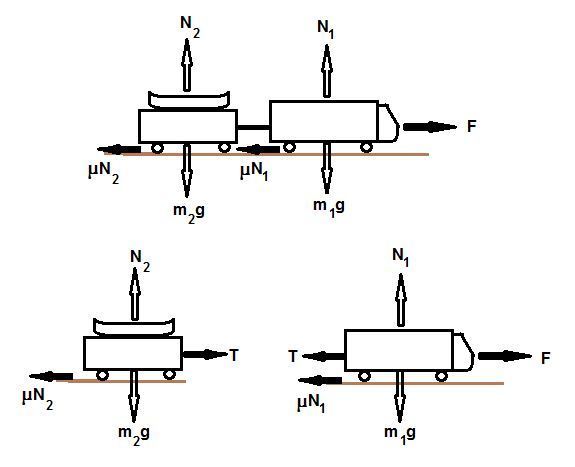
A 1100kg car pulls a boat on a trailer. (a) what total force resists the motion of the car, boat,and trailer, if the car exerts
likoan [24]
Refer to the figure shown below.

m₁ = 1100 kg, the mass of the car
m₂ = 700 kg, the mass of the trailer and boat
F = 1900 N, the driving force acting on the car
N₁ = m₁g,  the normal reaction on the car
N₂ = m₂g, the normal force on the trailer and boat
μN₁ and μN₂ are frictional forces, where  =  kinetic coefficient of friction
T = the force in the hitch between the car and trailer.

Part (a)
Let R₁ = the total force that resists the motion of the car, boat, and trailer.
Because the acceleration is 0.550m/s², therefore
(m₁ + m₂ kg)*(0.55 m/s²) = F
(1100+700 kg)*(0.55 m/s²) = (1900 - R₁) N
990 = 1900 - R
R₁ = 910 N

Answer: The resistive force is 910 N

Part (b)
80% of the resistive forces are experienced by the boat and trailer.
Let the resistive force be R₂.
Then
R₂ = 0.8*R₁ = 728 N
If the tension in the hitch between the car and the trailer is T, then
T - R₂ = m₂(0.55 m/s²)
(T - 728 N) = (700 kg)*(0.55 m/s²)
T - 728 = 385
T = 1113 N

Answer: The force in the hitch is 1113 N

3 0
2 years ago
Other questions:
  • Which statement correctly describes the electrons in a water molecule?. . A.Which statement correctly describes the electrons in
    7·2 answers
  • Raphael refers to a wave by noting its wavelength. lucinda refers to a wave by noting its frequency. which student is correct an
    15·1 answer
  • An object pulled to the right by two forces has an acceleration of 2.5 m/s2. The free-body diagram shows the forces acting on th
    14·2 answers
  • After a 60-kg person steps from a boat onto the shore, the boat moves away with a speed of 0.60 m/s with respect to the shore. I
    13·1 answer
  • A uniform thin circular rubber band of mass M and spring constant k has an original radius R?
    11·1 answer
  • Many birds can attain very high speeds when diving. Using radar, scientists measured the altitude of a barn swallow in a vertica
    15·1 answer
  • A 1200 kg car reaches the top of a 100 m high hill at A with a speed vA. What is the value of vA that will allow the car to coas
    12·1 answer
  • You testify as an expert witness in a case involving an accident in which car A slid into the rear of car B, which was stopped a
    14·1 answer
  • If the briefcase hits the water 6.0 s later, what was the speed at which the helicopter was ascending?
    6·1 answer
  • A small town has decided to forego the use of electrical power and send energy through town via mechanical waves on ropes. They
    12·1 answer
Add answer
Login
Not registered? Fast signup
Signup
Login Signup
Ask question!